Showing posts with label image. Show all posts

Thursday, 15 September 2016

The Knack Quiz


PLATFORM CLOSING EVENT: THE KNACK

FRIDAY 26 AUGUST, 7 - 9PM

A Pub-Style Quiz

This pub-style quiz marks the end of Glen Stoker and Anna Chrystal Stephens’ Platform Residency, There Are No Firm Rules. The quiz will take place within the two project installations in the gallery. The questions will be drawn from facts and trivia relating to and emerging from the residency.

Come on your own or in a team of up to 4 people.

Beer available, prizes for the winning team.

No modern knowledge-sharing tech: Check your phone in (safely) at reception!


Monday, 22 August 2016

Of The Day #15 - Plant - Rowan

Rowan, Mountain Ash

The rowans or mountain-ashes are shrubs or trees in the genus Sorbus of the rose family Rosaceae. They are native throughout the cool temperate regions of the Northern Hemisphere.

The name "rowan" is recorded from 1804, detached from an earlier rowan-tree, rountree, attested from the 1540s in northern English and Scottish.

Rowan is used as a food plant by the larvae of some Lepidoptera species - butterflies and moths and may account for the eggs found on a leaf and recorded in an earlier post here. with a full list here

The Rowan bears fruit in abundant clusters in the late summer and early autumn - and are really attractive to birds - leading to a colloquial name - bird catcher

The tree was also called wayfarer's tree or traveller's tree because it supposedly prevents those on a journey from getting lost. 


The fruits of European Rowan (Sorbus aucuparia) are edible! though bitter when raw, this disappears once heated or frozen - Rowanberries can be
- made into a slightly bitter jelly which in Britain is traditionally eaten as an accompaniment to game
- into jams and other preserves, on their own, or with other fruit.
- a substitute for coffee beans,
- used in alcoholic beverages: to flavour liqueurs and cordials, to produce country wine, and to flavour ale.

In Austria a clear rowan schnapps is distilled which is called by its German name Vogelbeerschnaps. Czechs also make a Rowan liquor called jeřabinka and the Welsh used to make one called diodgriafel.


Some Recipes


Rowan Jelly
A beautifully clear jelly made from rowan berries and apple.

900g cooking apples
1.3kg rowan berries
1 litre water
450g sugar per 600ml juice

Put all the fruit in a large preserving pan and barely cover with water. Bring to the boil, then simmer for 20 minutes or until the fruit is soft. Allow to drip through a jelly bag overnight.
Measure the juice and weigh out the correct amount of sugar. Add the juice and sugar to the cleaned preserving pan, and simmer over a low heat for 10 minutes until the sugar has dissolved.
Increase the heat and cook at a full rolling boil for 5 minutes, then test for a set. (see tips on jelly making below). When the jelly has reached setting point, pot into hot, sterilized jars, seal and label.

Cook apples in boiling water until soft. Add the rowan berries and reduce to a mush. then strain through a jelly bag overnight. Measure the juice and add correct amount of sugar. Boil until the liquid has reduced giving a thickened texture. Skim off any scum then bottle in sterile containers.

Rowan syrup
High in Vitamin A & C, stimulates the metabolism.

1kg ripe rowan berries
450g sugar
2 tsp salt (to counteract the bitterness of the rowan berries)
3l water

Sort your berries or hips out, removing sticks and any spoiled ones. Chop roughly and
put into a large saucepan. Cover with water to 2 or 3 cm above the berries. (About 2 litres of water
per 1 kg of fruit). Bring to the boil. Simmer for 15 minutes. Remove from the heat. Roughly mash the
berries with a potato masher to release all the juice. Leave to cool for 15 minutes or so. Strain through
a jelly bag (or piece of muslin) and put the berries back in the pan and add one more litre of water. Repeat then strain.
For each litre of juice add 300 g of sugar. Heat and stir until the sugar dissolves. Bring to the boil and boil for 5 minutes. Pour into sterilised bottles, cap and leave to cool. Can be kept in a cool dark place for up to a year.

Rowanberry Wine 

2kg rowanberries, snipped off with scissors, picked over and washed
1.2kg sugar
500ml white grape juice concentrate
Juice of 2 lemons
1 tsp of wine tannin
1 tsp pectolase
1 tsp yeast nutrient
Sachet of white wine yeast
About 4 litres of boiling water

Put the berries in a food grade plastic bucket and mash them coarsely with the end of a rolling pin. Boil the water then stir in the sugar until dissolved, bring to the boil again and immediately pour over the berries. Cover and allow to cool. Add the grape concentrate, pectolase, lemon juice and tannin. Cover and leave for 24 hours then stir in the yeast nutrient and yeast (activated if necessary).
Cover and leave for a week, stirring every day for the first five days. If your brew has separated nicely into three layers – sludge / liquid / sludge – carefully place the end of a siphon at a strategic height and siphon off the liquid into a clean demi-john – though a bit of sludge won't hurt. Otherwise strain through clean muslin using a funnel. Top up to the bottom of the neck with boiled and cooled water if necessary. Fit your bung and fermentation lock and leave to ferment for a couple of months.
Rack off into a fresh demi-john and leave until all fermentation has stopped for a week, then bottle. Rowanberry wine benefits from a long maturation period in the bottle – at least a year.

The fruit has many health benefits - however - when rowan berries are picked in the wild, they contain high levels of parasorbic acid, which can actually cause kidney damage, indigestion, and a range of other illnesses. Once frozen or heated, though, this acid changes to the beneficial sorbic acid, which our body finds very useful.

It's unlikely that anyone would keep eating the raw berries -they are very very bitter!


This haul was harvested from the site of our SURVEY event - where as with many other areas of British cities, the Rowan is planted as part of a civic planting scheme. This means cities in August will always offer an abundant berry harvest for birds and humans alike!

Saturday, 20 August 2016

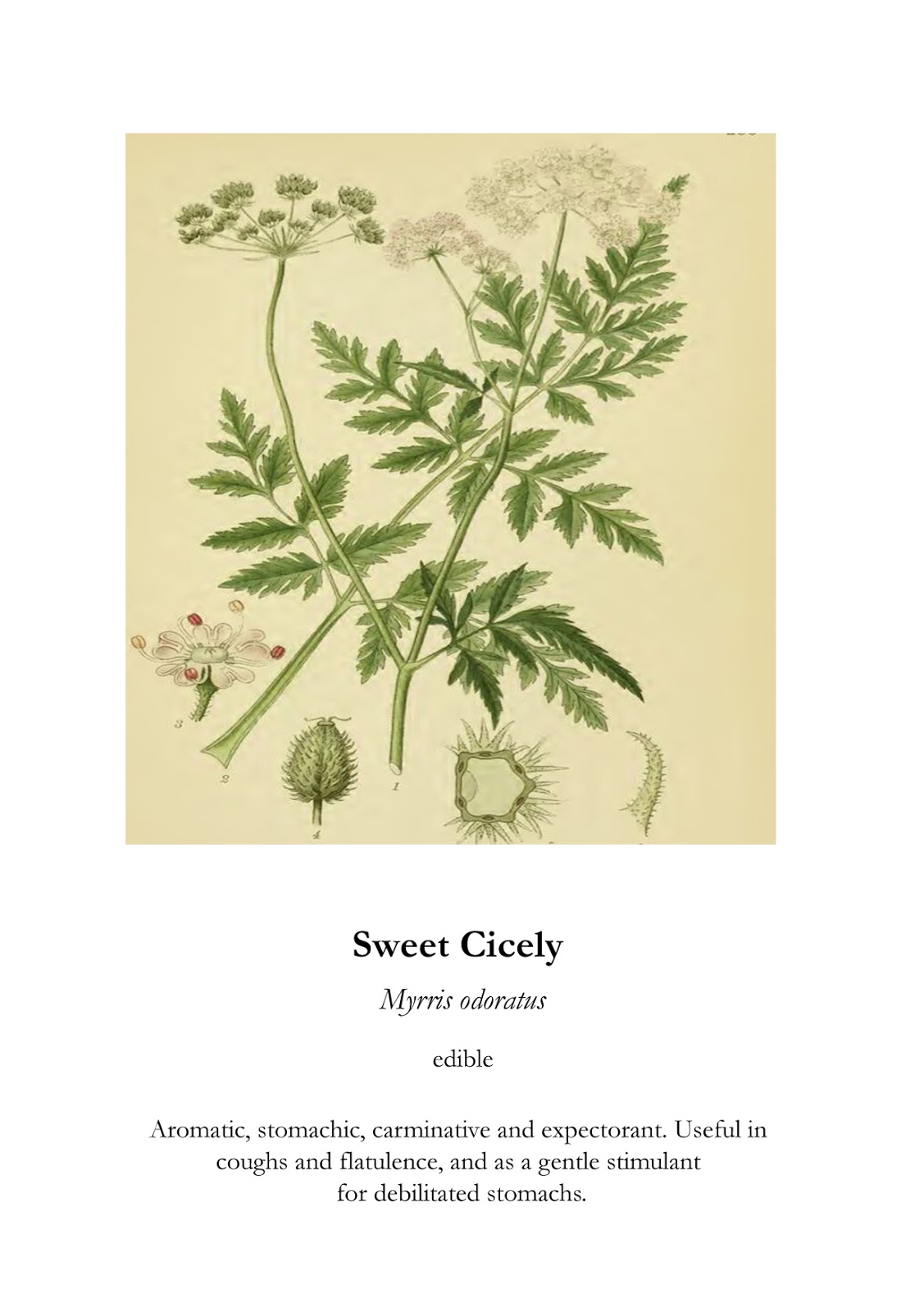
Of The Day #13 - Plant - Sweet Cicely


Sweet Cicely
Myrrhis odorata

a tall herbaceous perennial plant growing to 2 m [6 ft 6 in] tall, depending on circumstances. The leaves are fern-like, 2-4-pinnate, finely divided, feathery, up to 50 cm long, with whitish patches near the rachis. The plant is softly hairy and smells strongly of aniseed when crushed. The flowers are creamy-white, about 2–4 mm across, produced in large umbels. The flowering period extends from May to June. The fruits are slender, 15–25 mm long and 3–4 mm broad.

Introduced and naturalized in the UK in cultivated areas, woodland margins, roadside verges, river banks and grassland - its leaves are sometimes used as a herb, either raw or cooked, with a rather strong taste reminiscent of anise. The roots and seeds also are edible and has a history of use as a medicinal herb.

Friday, 19 August 2016

There Are No Firm Rules - Platform Residency - Group Action

Litter Picking in The Sheaf Valley


A Group and Community activity to keep the Sheaf Valley area of Sheffield clean and tidy. This area which comprises the Park Hill estate has had a poor reputation in the city - house prices generally a third lower than in the city's west.

The Friends of the Sheaf Valley, which was set up to promote the area, programme public events and encourage community engagement, regularly walks its streets collecting and disposing of litter.

It's a two-stranded endeavour - obviously, the area benefits from the reduction in lain waste - on this occasion a group of 20 people filled well over 30 bin bags in a 2 hour activity - but it seemed most important was the visibility through a performative presence - a pinked army - ready to engage with the community - taking an initiative with positive action.


There Are No Firm Rules - Platform Residency - The Building Society


THE BUILDING SOCIETY - OPEN NOW!

9 AUGUST - 27 AUGUST


Situated in Gallery 2, The Building Society is a library, resource centre and activity zone. The library is made up of over 200 books and magazines, covering aspects and concerns of Glen Stoker and Anna Chrystal Stephens’ Platform Residency, There Are No Firm Rules. These include DIY (homecrafts and skills); the Environment (factual nature, identification and cooking and medicinal books); and Theoretical texts around political and historical systems of living.

The library is free to use – visitors are invited to choose a book to read, converse with the artists and recommend some texts or donate some of their own relevant unwanted books.

http://www.sitegallery.org/archives/10104

Of The Day #12 - Book - Sapiens - A Brief History of Humankind


Sapiens: A Brief History of Humankind  by Yuval Harari

first published in Hebrew in Israel in 2011, and then in English in 2014 endeavours to show that it is possible to "ask very big questions and answer them scientifically".

From the sleevenotes -
100,000 years ago, at least six human species inhabited the earth. Today there is just one. Us. Homo sapiens. How did our species succeed in the battle for dominance? Why did our foraging ancestors come together to create cities and kingdoms? How did we come to believe in gods, nations and human rights; to trust money, books and laws; and to be enslaved by bureaucracy, timetables and consumerism? And what will our world be like in the millennia to come?

In Sapiens, Dr Yuval Noah Harari spans the whole of human history, from the very first humans to walk the earth to the radical – and sometimes devastating – breakthroughs of the Cognitive, Agricultural and Scientific Revolutions. Drawing on insights from biology, anthropology, palaeontology and economics, he explores how the currents of history have shaped our human societies, the animals and plants around us, and even our personalities. Have we become happier as history has unfolded? Can we ever free our behaviour from the heritage of our ancestors? And what, if anything, can we do to influence the course of the centuries to come?

Sapiens is the book we have chosen as the base text for a Reading Group event at Site Gallery - we are inviting each of 10 applicants to respond to our chosen excerpt with one of their own in response. Each chosen excerpt, as with ours, shoud take no longer than 2-3 minutes to read. Each applicant is invited to join us on a short circular walk around Sheffield, where the ten responsive texts will be read out at designated points along the way.

Here is our chosen text -


Thursday, 18 August 2016

A First Home

Shield Bug-lets

shield bug-lets?

Of The Day #11 - Object - Kombucha


Kombucha, colloquially known as Booch,  is a variety of fermented, lightly effervescent sweetened black or green tea drinks produced by fermenting tea using a "symbiotic 'colony' of bacteria and yeast" (SCOBY).

Historically, kombucha has been home-brewed or locally brewed, but in the late 1990s, commercially bottled kombucha became available in North American retail stores.

While there seems to be some disagreement, Kombucha has been promoted with claims that it can treat a wide variety of human illnesses, including AIDS, cancer, and diabetes, and that it provides other beneficial effects such as stimulation of the immune system, boosting the libido, and reversal of gray hair.

Kombucha culture, when dried, becomes a leather-like textile known as a microbial cellulose that can be molded onto forms to create seamless clothing. Using different broth mediums such as coffee, black tea, and green tea to grow the kombucha culture results in different textile colors, although the textile can also be dyed using plant-based dyes. Different growth mediums and dyes also change the textile's feel and texture. The kombucha textile is similar to cellulose and is sustainable and compostable. In 2014, one designer debuted a clothing collection made entirely out of kombucha textile.

Thanks to Lily Cameron for gifting these two bottles - a raspberry and an organic green tea - Lily has a facebook group all about Kambucha in Sheffield - Sheffield Loves Kombucha!

Lily provides some useful tips on how to enjoy your booch best -
  • Please always keep your Kombucha in the fridge - it’s naturally carbonated and things can get a bit too fizzy if it’s warm! (Seriously, it might EXPLODE!)
  • If you’re new to the Booch you need to give your body time to adjust, so take it slowly. For the first week, try drinking one small glass per day. You can increase to 3 small glasses per day in the second week and after that you can have all the lovely Kombucha you like :)
  • Most of the sugar in Kombucha is gobbled up by the beneficial yeasts & bacteria but if you’re diabetic or taking medication please do ask your doctor before drinking it
  • Kombucha is a fermented product so may contain a tiny amount of alcohol. It’s minimal but if you’re allergic it’s probably best to avoid
  • Keep metals away from your Kombucha as they can harm the good stuff
  • If you notice “bits” in your Booch, don’t worry! Your Kombucha is a natural, living culture and the bits are just those lovely yeasts & bacteria. You can drink them or filter them out with a coffee filter or nylon sieve if you prefer.

Wednesday, 17 August 2016

There Are No Firm Rules - Platform Residency - Wheat

Visit to Toby Hayam's allotment in the Park Hill area. Toby is growing various kinds of non commercial wheat, barley and other cereals. He aims to produce 30-40 kg of grain with which to make bread. He also has oats, which already taste great. He toured us through his project and the local vicinity and we discussed the difficulties of producing wheat in this way; it is very sensitive to the environment, must be harvested at the right time etc. We also discussed the differences in wheat now to the wheat of prehistoric times.


Afterwards we went to Toby and Kim's house on the edge of the park where they have built a community cob oven on the edge of the park land. We ate pizzas made in the oven with dough Kim had prepared, it was brilliant to sea the oven in action, temperatures reached more than 450 degrees!

We were also in the company of Linda, Dave, Tom, Katie and Carlo from the Sheaf community group, Friends of Sheaf Valley. The group organises community and environmental events, litter picking missions and other local focus stuff.

There Are No Firm Rules - Platform Residency - Reboot


There Are No Firm Rules - Platform Residency - Survey Area Response

We are in the process of interpreting the results of our 'Survey' activity.

Some images from Survey area...